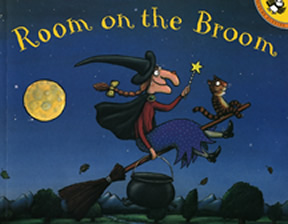
Room on the Broom
Written by Julia Donaldson, Illustrated by Axel Scheffler
Room on the Broom - plot activity with lesson plan
Last edited - August 15, 2026
Questioning is the foundation of all learning.
The first step in rejecting not knowing is to ask, why?
Sweetland
Introduction
A learning sequence plan with teaching suggestions and materials to review or introduce the story element plot with a read aloud, of the book Room on the Broom, by Julia Donaldson. Ideas are developed that can be used in a second lesson to explore the plot in another story with a there and back plot. Includes all materials to develop and achieve the outcomes.
Related study topics:
Planning information
Learner background information
A plan designed for learners who have prior knowledge in cause and effect, use of observations to make inferences and explanations for heard, visualized, and read stories. And social skills to work in groups.
Intended learnings & learners thinkings
Background information
Overview of the book
A tale told in verse about a witch flying around on a broom. As she whooshes around she accidentally loses possessions. Landing to retrieve them she is assisted in finding her lost possession and rewards the finder by adding them to her passenger list. Eventually the broom stick breaks in half. The passengers fall into a bog and the witch flies into a cloud where she encounters a dragon. Fleeing the dragon, who has intentions of feasting on witch and French fries, she lands in the bog where they both encounter a horrible beast from the bog. A clever climax follows and then a resolution where the witch asks each passenger to add something to her cauldron. She brews a better broom and flies off with her passengers. This is definitely a quality story. Outstanding use of words and story elements that can be shared and talked about with children that will encourage a journey toward literacy.
- Unpacking topics & standards
- Instructional Planning
- Literature genre
- Literature story elements
- Literature quality literature
- Plot worksheets
Quality literature concepts or outcomes
Big ideas and specific outcomes
Quality literature (media) goes beyond the usual and creates a very satisfactory response from the reader (user) which is created by the literary elements. Story consistency is created by the style which often uses repetition of events to create an easy and relaxing tone.
- Recognize magical items as wand, broom cauldron, witch.
- Recognize three objects were dropped, three characters were introduced, and three objects added to the cauldron, to build toward the climax of a new broom to accommodate her new friends.
- Recognize the animals acted like people.
Concepts and facts
- Rhythm can encourage the reader to continue reading and make the experience pleasurable.
- Unique plot can create a pleasurable and quality experiences.
- Tone creates quality through the attitude and feeling the author uses to bring a consciousness of the characters and the story.
- Style creates quality through the use of words, language, sentence construction, imagery... not what the author says, the way they say it. It adds significance and impact to the author's writing, uniqueness, and relevance of characters,
- The cause and effect of relationships has a definite impact on the quality of the story.
Outcome
Listen to the story and describe their responses and relate them to the quality of the literature and how they increased or decreased their interest in the story.
Identify unique and interesting examples from the story and explain why they believe they are.
Specific outcomes
- Identify and describe characteristics of plot that make the story better or worse.
- Describe the use of words they like and think make the story better.
- Describe what they think the authors thought about the characters.
- Describe what they think the author thought about the importance of the story.
- Describe why they think the author wrote the story.
- Describe what they liked about the relationships between events.
Literature elements
Big idea
- Plot is the order in which events move and happen in a story.
Foreshadowing is a hint of a future event in the plot.
Related concepts
- Chronological order in a story relates events in the order in which they happened.
- Sequence is the order in which events happen in time.
- A minimal sequence has a beginning, middle, and end.
- There can be multiple events in the beginning, middle, and end.
- There sometimes isn't a clear distinction between beginning, middle, and end.
- Events have causes and consequence.
- Events, causes, and consequences can range in intensity.
- Action can rise and fall.
- Climax: The peak and turning point of the conflict, the point at which we know the outcome of the action.
- Resolution: is the falling action after the climax. When the reader is assured that all is well and will continue to be, so the plot has a closed ending. Outcome -Plot -Identify and describe plot and its elements.
Outcome
Listen to the story, identify events of the story, sort the events in order, and label the order of events, plot.
- Chain events together in chronological order.
- Describe the sequence of events in the story.
- Describe the uniqueness of the events and the creative manner in which they are related.
- Identify and describe the rise and fall of action.
- Identify the rises to a climax and then trails off.
- Identify climax and resolution.
Anticipated learner thinkings & misconceptions
- When learners are told every story has a beginning, middle, and end; They don't want to subdivide or think that there can be more than one event in each.
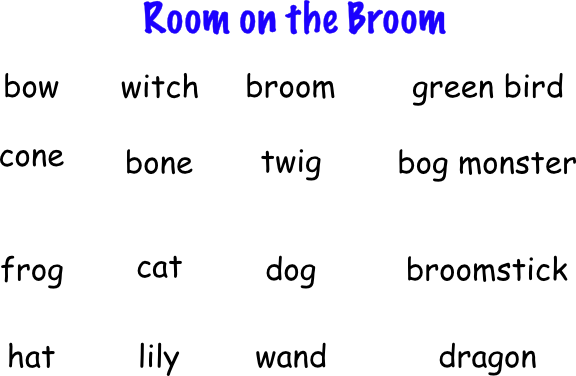
- For learners who need assistance with memory, use the pictures as tell the story. Give a learner the pics and maybe another the words. As they are introduced in the story have them place the pics with word in order.
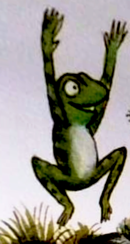
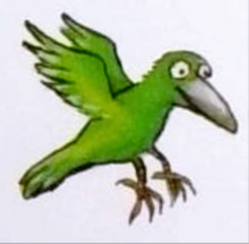
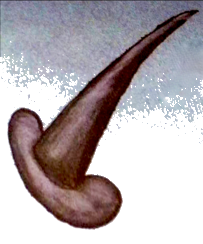
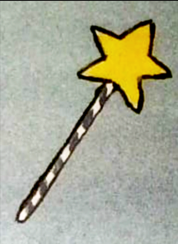
- Example - hat - dog bow - green bird wand - frog dragon - bog monster
- Ask what picture, in book best for last? Picture of all on newbrrom!
Genre
Fantasy
Related concepts and facts
- Fantasy is a subcategory of fiction. It is a made up story with magic, magical items, fantasy animals, use of three, good versus bad...
Outcome -
- Animals act like people (anthropomorphism).
- Characters can have special powers.
- Plot varies, but usually surprising twists or developments.
- Use of magic, magical items, fantasy animals, and use of three.
Specific outcomes -
- Recognize magical items as wand, broom cauldron, witch.
- Recognize three objects were dropped, and three characters were introduced to build toward the climax.
- Recognize the animals acted like people.
Scoring guides suggestions (rubric)
| Progressing | Excels | |||
|---|---|---|---|---|
| Story elements: Plot: | Reference to a story is a retelling without evidence of a systematic use of plot as a sequence of events. | Recognize and use plot in with references to beginning and ending events. | Recognize and use plot with references to beginning, middle, and ending events. | Recognize and use plot with references to all significant events relative to the plot of the story. |
| Genre characteristic: fantasy | Recognizes fact from fiction. | Recognizes real and made-up or fiction and non fiction or realistic and fantasy. | Explains fantasy as made up fiction that couldn't really happen and describe events in the story to support their reasoning. | Explains fantasy as beyond fiction and fantasy with the support of multiple common characteristics of the fantasy genre. |
| Quality literature | Identifies characteristics in stories they like. | Identifies characteristics in stories they like and provide a reason as to why. | Identifies multiple characteristics in stories they like and provide reasons as to why. | Identifies multiple characteristics in stories they like and provide reasons in an organized logical way that explains why the combination is or isn't quality. |
Pedagogical Overview
Strategies to achieve educational learnings
Based on learning cycle theory & method
Activities Plans & Sequence to provide sufficient opportunities for learners to achieve the targeted outcomes.
Make sure learners have the prior knowledge identified in the background information.
- Activity 1 - Introduce, read, discuss, plot line ...
- Activity 2 - Repeat procedure with a there and back book.
Focus question
Unit focus question:
What is plot?
Materials
- File to print out - plot phrases.pdf
- Journal 1 - Plot notes
Resources
Lesson Plans
Activity 1 - Introduce, read, discuss, plot line ...
Materials
- prints of - plot phrases.pdf
- pics with vocabulary words
- Journal
Focus questions:
- What is plot?
Learning outcomes:
- Listen to the story and describe their response and relate them to the quality of the literature and how they increased or decreased their interest in the story.
- Listen to the story, identify events of the story, sort the events in order, and label the order of events, plot.
- Identify the story as fantasy, fiction, ...
Suggested procedures overview:
- Put learners in groups, focus their attention, and assess their initial understanding of the focus questions.
- Listen to the story and describe their response and relate them to the quality of the literature and how they increased or decreased their interest in the story.
- Listen to the story, identify events of the story, sort the events in order, and label the order of events, plot.
- Identify the story as fantasy, fiction, ...
Exploration - Diagnostic
- Gather the learners as a group.
- Don’t show them the book.
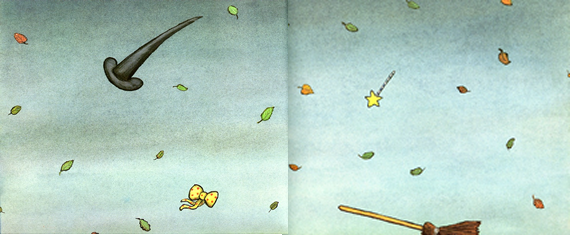
- Secretly open to and Display the two page spread before title page (Bow, Hat, Wand, Broom).
- Ask. Why do you think the illustrator drew these? They might be in the story. Accept all answers
- Do you think they will be important? Accept all answers
- Why or why not? Accept all answers
- What part do you think they might have?
- Will it relate to the characters?
- Which one? main
- What are the objects? Hat, broom, bow, wand
- How are they used? Accept all answers
Read. the story and try to emphasize the following events in the story and how some events were the cause of another.
Optional
Can give a pair of learners the pics and maybe another pair the words. As they are introduced in the story have them place the pics with word in order.
Example
- hat - dog
- bow - green bird
- wand - frog
- dragon
- bog monster
- Ask what picture, in book best for last? Picture of all on new broom!
Start with
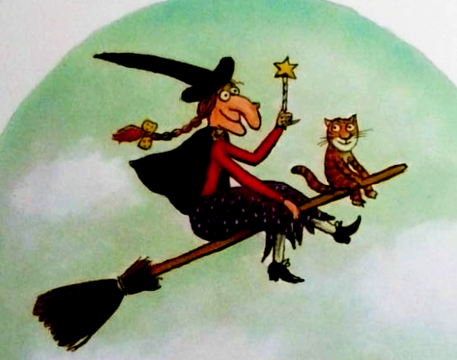
- The witch had a cat and a hat that was black... (also bow, broom, and wand)
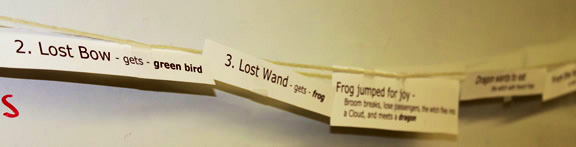
- Lost hat -get dog
- Bow -green bird
- Wand -frog
- Frog jumped for joy
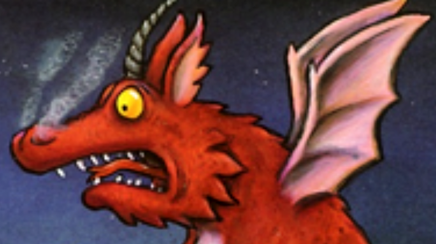
- Broom breaks - lost passengers, and the witch flies into a Cloud, and meets a dragon
Climax & resolution
- Witch and French fries= meal for the Dragon!
- Fly higher, breath fire, fly to ground, but no help could be found.
- Just this once I will eat witch without French fries.
- When get to the top of page that has. the following.
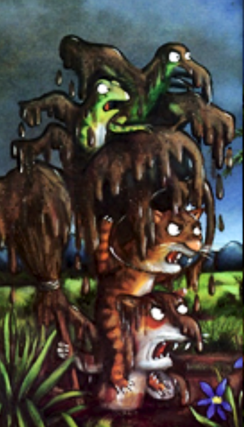
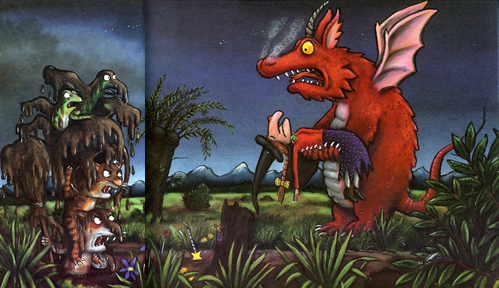
STOP SHOWING PICTURES.... - But just as he planned to begin on his feast, From out of a ditch rose a horrible beast. It was tall, dark, and sticky and feathered and furred. It had four frightful heads, it had wings like a bird. And its terrible voice,when it started to speak, Was a yowl and a growl and a croak and a shriek. It dripped and it squelched as it strode from the ditch,
- And it said to the dragon,
BUZZ off! THAT’S MY WITCH! - Ask. What do you think the horrible beast is?
- What became of the passengers?
- READ - “Without you I’d be in that dragon’s inside .”
- ASK. Could it end here?
- Is there more you would like for the story? What?
- Are there events in the story that need to be fixed? What might they be? How might they be fixed?
- SHOW rest of book as read ...
- Read rest of the story.
- Asks each character to find something and throw it in the cauldron
- Frog -lily, Cat -cone, Bird -twig, Dog -bone Brew broom with - seats, nest, pool
- View last plate same as first.…
- Ask what they liked about the story and why?
Invention -
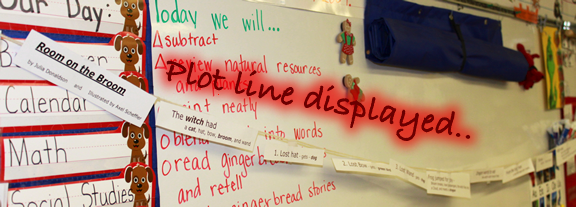
- Story map - create - see story parts in plot phrases.pdf file.
- Either
- clip to a yarn or cord to string up or let dangle. Or
- put labels on roll out mural ... like chart ...
- Ask what genre? Fantasy -use of three (problems -lose hat, bow, wand), use of magic, and mythological characters (dragon) SEE FILE ...
- What makes a quality fantasy? Is this one?
Summative
Ask learners to summarize the story using the plot sequence.
Use the photo from the beginning of the book and the one with the monster and dragon and Ask. Where do these pictures belong on the plot line.
Discover - Expansion - Generative
- Story elements - Application to other stories using beginning, middle, and end as reference points to sequence events for plot. Recognizing foreshadowing in other stories.
- Genre - Recognize fantasy as a subcategory of fiction with ... When reading, listening, or viewing other fantasy stories and explain why the are fantasy.
- Quality literature - Use characteristics of genre or story elements to explain why they believe a story is quality or not.
Activity 2 -
Materials:
- Select another story. Maybe a there and back story:
- Rosie's Walk Pat Hutchins (1971)
- Chicken Little, Steven Kellogg. (1985)
- The Gruffalo, Julia Donaldson. (1999)
- We're Going on a Bear Hunt By, Michael Rosen (1997)
- Journal
Focus questions:
- What is plot?
Learning outcomes:
- Listen to the story and describe their response and relate them to the quality of the literature and how they increased or decreased their interest in the story.
- Listen to the story, identify events of the story, sort the events in order, and label the order of events, plot.
- Identify the story as fantasy, fiction, ...
Suggested procedures overview:
- Put students in groups, focus their attention, and assess their initial understanding of the focus questions.
- Activity - Read aloud a book and make an outline for the plot or complete on of the Plot worksheets.
Exploration
- Put learners in pairs.
- Read ....
- D0 ...
Invention
- Recall and review
Discover
Journal for activities
Journal 1 -
Materials
Focus questions:
- What is plot?
Challenge
Describe the plot of Room on the Broom
Room on the Broom pics & word bank
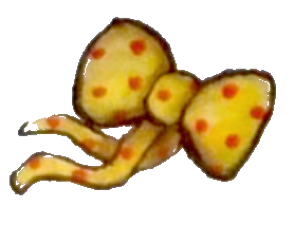
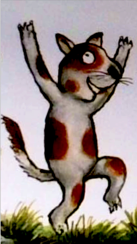
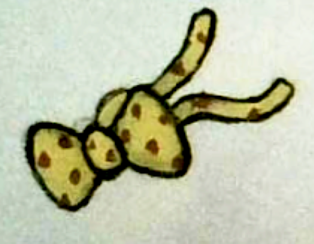
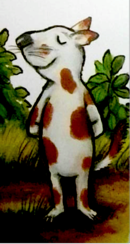
Word bank
Generative assessment pics
Support materials for
Room on the Broom - plot exploration
Written by Julia Donaldson Illustrated by Axel Scheffler
File to print out - plot phrases.pdf
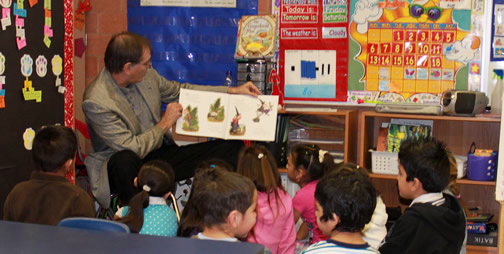
After reading the book.
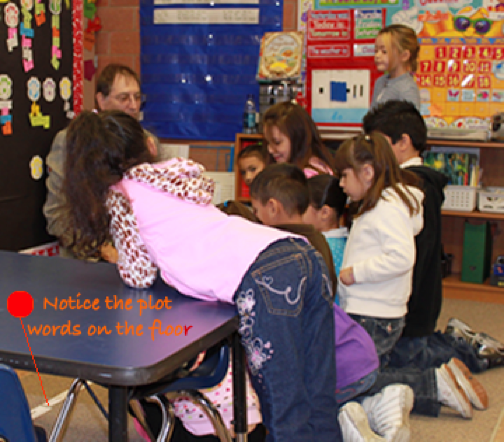
Getting ready to start sorting the plot lines.
Word bank - vocabulary
Plot - the main events of a media piece - story, book, play, novel, movie, or similar work, devised and presented by the writer as an interrelated sequence of events.
Story elements – character, setting, plot, point of view, theme, tone, style.
Foreshadowing - language, images, ... that hints at future events in a story.
Genre – fiction, nonfiction, fantasy.
Quality literature – any literature that includes elements to engross the reader, listener, user to respond in positive ways.
Home: Pedagogy - theory, curriculum, learning, human development, & teaching
Home: Literature - story elements, genre, media, pedagogical knowledge, language arts