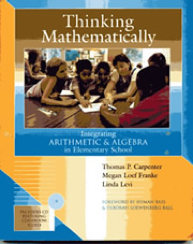
Thinking Mathematically: Integrating Arithmetic and Algebra in Elementary School. by Thomas P. Carpenter, Megan Loef Franke, & Linda Levi, Heinemann:Portsmout. 2003
Classroom videos are included on a CD that accompanies the book.
Overview
Thinking Mathematically: Integrating Arithmetic and Algebra in Elementary School provides a framework for fostering algebraic thinking, such as relational thinking and understanding properties, within elementary arithmetic. It emphasizes that algebraic reasoning is not just for high school, but should be integrated into K-5 mathematics through exploration and classroom dialogue.
Chapter-by-Chapter Summary
Chapter 1: Developing Mathematical Thinking examines what children. Their conceptions and misconceptions about numbers and symbols. It highlights that children possess informal knowledge of arithmetic properties that can be built upon to foster algebraic understanding, as a gateway to understanding rather than closed door.
Chapter 2: Equality addresses the common misconception of the equals sign ( = ) as a signal to compute answer, rather than as a relational symbol indicating equivalence between two expressions (e.g., 7 + 8 = 7 + 7 + 1 ).
Chapter 3: Developing and Using Relational Thinking discusses encouraging students to look for relations among numbers and operations rather than computing the answer. It introduces using number properties (like commutativity or associativity) to simplify calculations.
Chapter 4: Making Conjectures About Mathematics discusses how students can form, test, and articulate generalizations about mathematical properties. It covers the process of moving from specific numerical examples to general statements.
Chapter 5: Equations with Multiple Variables and Repeated Variables describes how to help learners use algebraic notation to express their generalizations (e.g., x + y = y + x ) where many numbers can be substituted for x and y to make the equation true. While values for variables in an equation can have several values, they must remain the same for the substitution of the same variable in the same equation. x + x + y = 14. ( 4 + 4 + y ) y = 6 or ( 1 + 1 + y) or y = 12.
Chapter 6: Representing Conjectures Symbolically describes how learners words describing their intuitive answers to justify their conjectures using logical reasoning can be represented with symbols. It also outlines the development of proof, focusing on providing evidence to prove the general rather than just checking answes.
Chapter 7: Justification and Proof explores what counts as justification and proof for different levels of justification. Authory, example, examples, and generalizable agruement.
Chapter 8: Ordering Multiple Operations explores how to present operations with more than two numbers and how the order they should be operated on when there are. Enables cnojectures and proof for + - * / and the associative and distributive property.
Chapter 9: If... Then... Describes how operations on both sides of an equation can be used to prove conjectures. If x = y, then x + c = y + c
| Movie title on CD and Time | Topic | Notes |
|---|---|---|
|
Video - 1:40 |
Equality: |
Read number sentence and tell me what to put in the box; Reads says "same as" for = ; Can you tell ... __ ; counts on fingers ... |
|
Video - 3:02 |
Equality: |
First grade Why 5? Didn't knowif 5 or 7 ... Same as the 6+2, because 57&56 are related like 38&39 |
|
Video - 10:19 |
Equality: 8+4=___+5 |
Fourth grade |
|
Video - 17:45 |
Relational Thinking 7+6=__+5 |
Second grade |
|
Video - 6:11 |
Relational Thinking 7+6=__+5 |
Second grade Write true false; How did you know that was true so fast?; say again, I am not sure I am hearing it...; How know without ever adding the numbers?; ... ; Prove to me; They are in a different order of adding them; Have to have two numbers can't switch them around in the number... (((Why didn't teacher explore this?))) What am I doing with switching?... A lot of conjectures... Need to write down to keep track of.... ............................ |
|
Video - 4:59 |
Relational Thinking 3*7=7+7+7 |
Third Grade How many sevens did I say?; Why don't you read it?; True because * is same |
Class demonstration equations - true or false Video - 4:10 |
Conjectures: 98+0=98 |
First/second combination Class discussion 10+0=__; Student demonstrates with 10 blocks; Think we have a conjecture going here; Writes, If you add 0 to a number, then ... Maybe any number minus zero... |
|
Video - 8:01 |
Conjectures A Conjecture Comes Up in Class Discussion Conjecture, read out loud, is it true? a+b-b=a |
Second grade Try numbers, regular, super high, super low... Work with different types; Not completely, because can't do infinity; 1/2+11-11=1/2; 5+5-5=5; 5+ -5 --5 =5; rewrite the conjectures; b-b is always 0 ; other conjecture is a+0=a; If you put two conjectures together and they are always true, then it would prove the third is true. Which is better way to prove? this way would take your hole life... |
|
Video - 2:41 |
Open Number Sentences b+b+b-20=16 |
Fourth grade |
|
Video - 1:52 |
Open Number Sentences k+k+13 = k +20 |
Fourth grade What would k have to equal for that to be a true number sentence? What made you think to try 7? Why did you know that k+13=20? |
|
Video - 1:29 |
Justification Odd + odd = even |
Conjecture - proves by drawing lines on white board and pairing. |
|
Video - 3:08 |
Justification 0*5=5*10 |
Second grade |
8.1 - 3:28 Further Justification |
If you add odd to odd you get even |
Fourth grade m + m + 1; Matter what m is? No it is the mathematician's role. What if m = 3 1/2? Can't be a fraction.; Then I will add another b+b+1 and if add both of them, get m + m + 1 + b+b+1 = 2m + 2b + 2 ... Can never do every sample that's out there. |
Math professional explorations directory
Videos
Kevin
David
Lillian
Emma
Megan
Kenzie
Class demonstration equations - true or false
Susie
Allison
Cody
Thad
Allison 16