

Property is a an attribute, quality, or characteristic of something.
Or more specifically in mathematics:
Properties are the fundamental rules that describe how numbers behave during addition, subtraction, multiplication, and division.
Properties in arithmetic include:
- Identity property
- Inverse property
- Property of zero
- Commutative property
- Associative property
- Distributive property of multiplication over addition
Information on each and how they work with different operations follows.
Properties of addition and subtraction
| Number sentence |
Primary Conjecture |
Property & conditions | True/False Statements |
|---|---|---|---|
| n + 0 = n | The identity property is a process that yields the same number. When you add zero to a number you get that same number. |
Identity property of addition: For every real number n + 0 = n |
|
| 0 + n = n | The identity property is a process that yields the same number. When you add a number to zero you get that same number. |
Identity property of addition: For every real number 0 + n = n |
|
| n - 0 = n | The identity property is a process that yields the same number. When you subtract zero from a number you get that same number. |
Identity property of subtraction: For every real number n - 0 = n |
|
| n - n = n | The inverse property is a process that undoes another process. When you subtract a number from itself you get zero. |
Inverse property of addition: For every real number n, there is a real number -n such that n + (-n) = 0 |
|
n + 5 = x x - 5 = n |
The inverse property is a process that undoes another process. When you add a number to a number it can be undone by subtracting the number |
Addition is the inverse of subtraction. Subtraction is the inverse of addition. |
5 + 2 = 7 8 - 3 = 5 |
Properties of multiplication and division
| Number sentence |
Primary Conjecture |
Property & conditions | True/False Statements |
|---|---|---|---|
| n * 1 = a | The identity property is a process that yields the same number. When you multiply a number times 1 you get that same number. |
Identity property of multiplication: For all real numbers a, a * 1 = a |
3 * 1 = 3 |
| 1 * n = n | The identity property is a process that yields the same number. When you multiply 1 times a number, you get that number. |
Identity property of multiplication: For all real numbers a, a * 1 = a |
1 * 4 = 4 |
| n / 1 = n | The identity property is a process that yields the same number. When you divide a number by 1, you get that number. |
Identity property of division: For all real numbers a, a / 1 = a |
5 / 1 = 5 |
| n / n = 1, n ≠ 0 | The identity property is a process that yields the same number. When you divide a number by itself you get one, except when the number is zero. |
Identity property of division: For all real numbers a, a / a = 1 |
6 / 6 = 1 |
| n * 1/n = 1 | The inverse property is a process that undoes another process. When you multiply a number, number not equal to zero, by it's inverse 1/n the product is 1., |
Inverse property of multiplication: For every real number n, n ≠ 0, there is a real number 1/n such that n * 1/n = 1 |
3 * 1/3 = 1 |
Properties of multiplication and division with zero
| Number sentence | Primary Conjecture | Property & conditions | True/False Statements |
|---|---|---|---|
| n * 0 = 0 |
The property of zero is a process that when you multiply a number times zero, you get zero. | Property of zero | 2 * 0 = 0 |
| 0 * n = 0 | The property of zero is a process that when you multiply zero times a number, you get zero. | Property of zero | 0 * 3 = 0 |
0 / n = 0, a ≠ 0 |
The property of zero is a process that when you divide zero by any number except zero you get zero. | Property of zero | 0 / 0 = 0 |
Commutative property for addition and multiplication
| Number sentence | Primary Conjecture | Property & conditions | True/False Statements |
|---|---|---|---|
| a + b = b + a | The commutative property for addition is when you add two numbers, you can change the order of the numbers you add, and you will get the same answer. | Commutative property of addition: the order in which a pair of addends is added does not affect the sum. For all real numbers a and b, |
4 + 3 = 3 + 4 1 + (2 + 3) =
|
| a * b = b * a | The commutative property for multiplication is when multiply two numbers, you can change the order of the numbers you multiply, and you will get the same answer. | Commutative property of multiplication: the order in which a pair of factors is multiplied does not affect the product. For all real numbers a and b, |
2 * 3 = 3 * 2 2 (3 * 4) = 2(4 * 3)
|
| a * (b + c) = (a * b) + (a * b) |
The distributive property of multiplication over addition is the process that when an operation is performed on two or more quantities after they are combined by another operation, the result is the same as when it is performed on each quantity individually and then another operation is performed to combine them. | Distributive property of multiplication over addition: For all real numbers a, b, c, |
2(3 * 4) = (2 * 3) + (2 * 4) |
Associative property
Associative property of addition: the sum of three or more numbers is the same regardless of how the numbers are grouped (use parentheses) or are added.
Represented with Cuisenaire rods.

Commutative property
Addends can be added in any order.


Factors can be multiplied in any order.
R X P = P X R

Distributive property of multiplication over addition model
Distributive property with tiles or pattern blocks or squares
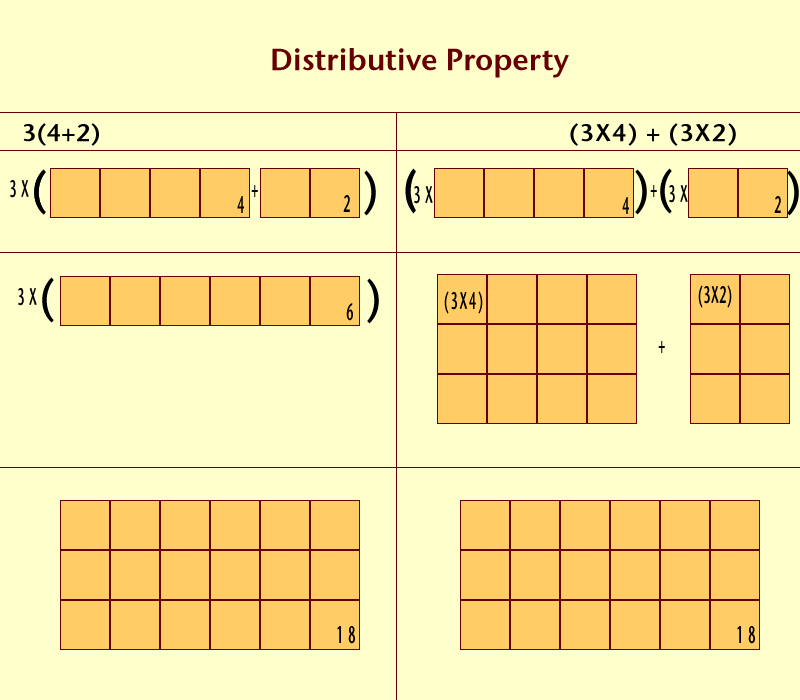
Distributive property of multiplication over addition:
For all real numbers a, b, c,
a × (b + c) = (a × b) + (a × b)
Represented with Cuisenaire rods.
(P × R) + (P × G) = P × (R + G)


Inverse operation sample problems:
Mom asked me how many carrot sticks I wanted. I said six. She was talking and put ten on my plate. I said ... Mom! And she said Oh! I wasn't thinking, How many does she have to remove?
I went to the kitchen as Dad bought the pizza in. I grabbed the two pieces, I want and my brother yelled bring me two. I added two to my plate and went back to the other room. How many pieces of pizza does my brother have to take so I have my two slices.
Other inverse operation:
- Squaring a positive number can be undone by taking the square root of the result.
- A quantity scaled by a factor of n can be returned to its original size by scaling the results bu a quantity of 1/n.
- Given an input value, a function produces an output, whereas an inverse function takes an output and undoes the operations of the original function to restore the input.