Math Books for Professional Math Educators
Comprehensive math methods books
Elementary and Middle School Mathematics: Teaching Developmentally. 2022
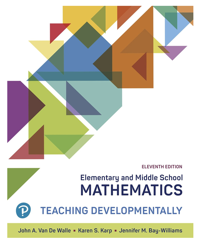 A comprehensive book for teaching mathematics for the K-8 learner. John has had numerous editions over the years. His text is a classic for elementary teacher education.
Mathematics, a Good Beginning: Strategies for Teaching Children. 2002
Is a comprehensive respected, best-selling textbook designed for educators, offering practical, activity-based strategies for K-8 classrooms. It emphasizes fostering mathematical competence, confidence, and foundational skills aligned with current research and NCTM recommendations.
Math Teaching in Practice Series
Math Teaching in Practice Series.
NCTM and Teachers College Press will launch a new Math Teaching in Practice Series.
A collaboration, that promises to combine the profession's leading-authority figures with a fresh voices.
Their goal is to provide classroom teachers with research-based, implementable resources that will have an immediate impact on their mathematics instruction.
This series will leverage the strengths of both NCTM and TCP and help teachers level-up to the benefit of each and every learner.
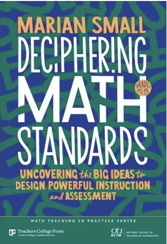 The first four books in the Math Teaching in Practice Series™ will be published in Fall 2026:
- Deciphering Math Standards: Uncovering the Big Ideas to Design Powerful Instruction and Assessment (Grades K-8) by Marian Small (publication August 28, 2026)
- Decluttering Mathematics: 5 Fundamental Understandings That Unleash Meaningful Student Thinking (Grades 6-12) by Ted Coe, April Strom, Scott Adamson, and James Tanton (publication September 25, 2026)
- Fractions Unlocked: How Teaching Fractions as Numbers Is the Key to Student Understanding by DeAnn Huinker and Elizabeth Cutter-Lin (publication September 25, 2026)
- When Math Gets Tough: Guiding Students Through Productive Struggle for Deeper Learning (Grades K-5) by Lorelei Coddington and Stacy Kula (publication December 18, 2026)
Young Mathematicians at Work Series
Mathematicians at Work: Constructing Number Sense, Addition, and Subtraction. 2001: Heinemann, Portsmouth, NH. pages 182
ISBN-13: 0-325-00353-x.
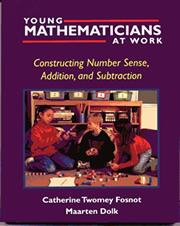
Excellent information of how mathematical understanding can be facilitated in children with a specific focus on mathematical instruction for constructing mathematical ideas (sign-posts) conceptually for learning about number value, addition, and subtraction.
Chapter titles:
- "Mathematics" or "Mathematizing"?
- The Landscape of Learning
- Number Sense on the Horizon
- Place Value on the Horizon
- Developing Mathematical Models
- Addition and Subtraction Facts on the Horizon
- Algorithms Versus Number Sense
- Developing Efficient Computation with Minilessons
- Assessment
- Teachers as Mathematicians
Mathematicians at Work: Constructing Multiplication and Division. 2001: Heinemann, Portsmouth, NH. pages 159
ISBN-13: 0-325-00354-8.
Excellent information of how mathematical understanding can be facilitated in children with a specific focus on mathematical instruction for constructing mathematical ideas (sign-posts) conceptually for learning about multiplication and division.
Chapter titles
- Mathematizing - describes and illustrates what it means to do and learn mathematics
- The landscape of learning - provides strategies to help teachers turn their classrooms into math workshops that encourage and reflect mathematizing
- Developing multiplication strategies and big ideas - examines several ways to engage and support children as they construct important strategies and big ideas related to multiplication
- Connection division to multiplication - takes a close look at the strategies and big ideas related to division
- Multiplication strategies - defines modeling and provides examples of how learners construct models with a discussion of the importance of context
- Algorithms versus number sense - discusses what it means to calculate using number sense and whether or not algorithms should still be the goal of computation instruction
- Developing Efficient Computation with Minilessons
- Assessment - describes how to strengthen performance and portfolio assessment
- Landmark ideas, strategies, models - emphasizes teachers as learners by encouraging them to see themselves as mathematicians.
Mathematicians at Work: Constructing Fractions, Decimals, and Percents. 2002: Heinemann, Portsmouth, NH. pages 159
ISBN-10: 0-325-00353-x.
Excellent information of how mathematical understanding can be facilitated in children with a specific focus on mathematical instruction for constructing mathematical ideas (sign-posts) conceptually for learning about fractions, decimals, and percents.
Chapter titles
- Mathematizing - describes and illustrates what it means to do and learn mathematics.
- The landscape of learning - contrasts word problems with true problematic situations which support and enhance investigation and inquiry.
- Equivalence on the Horizon - provides strategies to help teachers turn their classrooms into math workshops.
- Developing big ideas and strategies - explores the cultural and historical development of fractions, decimals, and their equivalents and the ways in which children develop similar ideas and strategies.
- Developing mathematical models - defines and gives examples of modeling, noting the importance of context.
- Algorithms vs. number sense - discusses calculation using number sense and the role of algorithms in computation instruction.
- Developing efficient computation with minilessons
- Assessment - describes how to strengthen performance and portfolio assessment.
- Landmark ideas, strategies, models - focuses on teachers as learners by encouraging them to see themselves as mathematicians.
Mathematicians at Work: Constructing Algebra. 2001: Heinemann, Portsmouth, NH. pages 192
ISBN-13: 978-0-325-02841-5.
Excellent information of how mathematical understanding can be facilitated in children with a specific focus on mathematical instruction for constructing mathematical ideas (sign-posts) conceptually for learning algebra.
It will help teachers recognize, support, and celebrate their students' capacity to structure their worlds algebraically.
It identifies the models, contexts, and landmarks that facilitate algebraic thinking in young students and provides insightful and practical methods for teachers, math supervisors, and curriculum coordinators.
It uses classroom vignettes to illustrate the investigations and mini-lessons learners engage in as they build their mathematical knowledge.
Chapter titles:
- Algebra: Structures or Structuring?
- The Landscape of Learning
- Early Structuring of the Number System
- Continuing the Journey: The Role of Contexts and Models
- Equivalence on the Horizon
- Variation versus Variables
- Further Horizons: Integers and Equivalence
- Comparing Quantities and Relations
- Developing Algebraic Strategies with Mini-lessons
- Proof
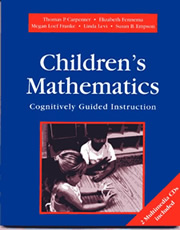
Children's Mathematics: Cognitively Guided Instruction. 2018
Has research-based information to understand developmental mathematical thinking.
It focuses on how children intuitively solve problems, promoting instruction that builds on student reasoning rather than relying solely on traditional algorithms.
Fits well with Fosnot's books.
Letters to a Young Mathematician. 2006: Joat Enterprises, Portsmouth, NH. pages 203
ISBN-13: 978-0-465-08231-5.
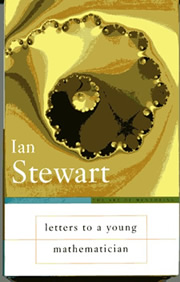
A collection of letters written by mathematicians about what it is like being a mathematician. Each can be read alone or as a series. Great reading for anyone interested in math and would be great to read one or two as read alouds in math classes fifth grade and above.
Powerful Problem Solving: Activities for Sense Making with Mathematical Practices. 2013: Heinemann, Portsmouth, NH. pages 192
ISBN-13: 078-0325-05090-4
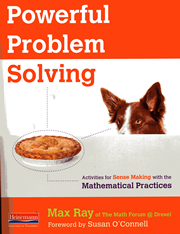
This book is an excellent source of information for teachers to learn or review how to facilitate learner's mathematical problem solving.
The authors apply George Polya's problem solving suggestions, in his book How to Solve It, and the ideas of the NCTM Process Standards: problem solving, representations, connections, communication, and proof and reasoning, to the eight categories of the Common Core Standards for Mathematical Practice.
It is an excellent source of detailed - how to information - with specific problem solving activities and suggestions to help teachers faciliate the development of not only problem solving, but learners' practices of mathematics.
Algebra related
Thinking Mathematically: Integrating Arithmetic and Algebra in Elementary School.. Heinemann:Portsmout. 2003
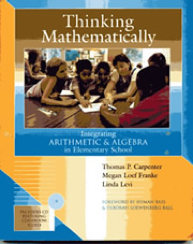
Thinking Mathematically: Integrating Arithmetic and Algebra in Elementary School provides a framework for fostering algebraic thinking, such as relational thinking and understanding properties, within elementary arithmetic. It emphasizes that algebraic reasoning is not just for high school, but should be integrated into K-5 mathematics through exploration and classroom dialogue.
- Developing Mathematical Thinking
- Equality
- Developing and Using Relational Thinking
- Making Conjectures About Mathematics
- Equations with Multiple Variables and Repeated Variables
- Representing Conjectures Symbolically
- Justification and Proof
- Ordering Multiple Operations
- If... Then... Statements
- Conclusion Answers for Selected Challenges
Fostering Algebraic Thinking: A Guide for Teachers Grades 6-10. 1999: Heinemann, Portsmouth, NH. pages 164
ISBN-10: 0-325-00154-5
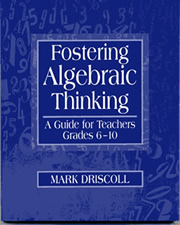
Great ideas for middle school teachers and above to implement as well as important information that al teachers should know about algebraic thinking so preschool and early elementary teachers understand the importance of providing students in the early grades opportunities to explore and play with mathematical ideas concretely so students will begin to connect a variety of external events to mathematical ideas so they will have a solid background of representations to use to construct understanding in algebra in their later grade experiences.
Mathematicians at Work: Constructing Algebra. 2001: Heinemann, Portsmouth, NH. pages 192
ISBN-13: 978-0-325-02841-5.
Excellent information of how mathematical understanding can be facilitated in children with a specific focus on mathematical instruction for constructing mathematical ideas (sign-posts) conceptually for learning algebra.
It will help teachers recognize, support, and celebrate their students' capacity to structure their worlds algebraically.
It identifies the models, contexts, and landmarks that facilitate algebraic thinking in young students and provides insightful and practical methods for teachers, math supervisors, and curriculum coordinators.
It uses classroom vignettes to illustrate the investigations and mini-lessons learners engage in as they build their mathematical knowledge.
Chapter titles:
- Algebra: Structures or Structuring?
- The Landscape of Learning
- Early Structuring of the Number System
- Continuing the Journey: The Role of Contexts and Models
- Equivalence on the Horizon
- Variation versus Variables
- Further Horizons: Integers and Equivalence
- Comparing Quantities and Relations
- Developing Algebraic Strategies with Mini-lessons
- Proof
The Roles of Representation in School Mathematics: 2001 Yearbook. 2001: NCTM. pages 282
ISBN-13: 978-0873534956.
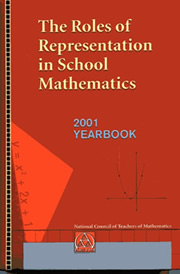
Want to know more about representation in mathematics K-12. This is a very good source with a collection of articles.
Teacing and Learning Proof Across the Grades: A K-16 Perspective. 2009: Routledge. pages 408
ISBN-13: 978-0415887311.
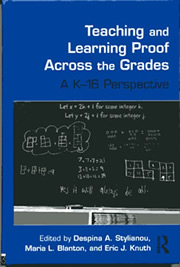
Great ideas about the importance of teaching proof, different types of proofs, and how to implement them to facilitate students learning them K-16.
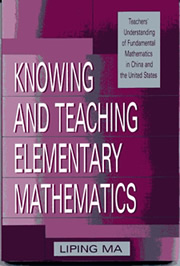
Knowing and Teaching Elementary Mathematics. 2010: , . pages 192
ISBN-13: 978-0805829099.
Knowing and Teaching Elementary Mathematics: Teachers' Understanding of Fundamental Mathematics in China and the United States (Studies in Mathematical Thinking and Learning Series)
Rules or theory - both.
Also a newer version: Knowing and Teaching Elementary Mathematics: Teachers' Understanding of Fundamental Mathematics in China and the United States (Studies in Mathematical Thinking and Learning Series). 2012
ISBN-13: 978-0415873840
232 pages
Children's Mathematics: Cognitively Guided Instrution (CGI). 1999: Heinemann, Portsmouth, NH. pages 110
ISBN-13: 978-0325001371.
The Simpsons and their Mathematical Secrets - 2014, Bloomsberry: New York. pages 213 ages 12+.
ISBN-13: 978-1-62040-277-1.
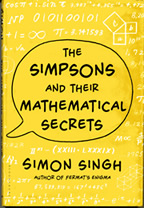
Excellent story for anyone that is a fan of the Simpsons, interested in mathematical ideas, trivia nut, Futurama fan, or people that are interested in stories behind the scene stories.
How to Solve It - 1945
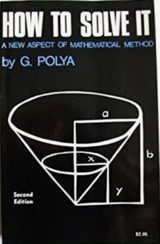
Classic, problem solving book and where George identifies a heuristic to use to systematically solve problems, which has been been found, by learners and educators, as a powerful tool for solving problems. In it he suggests a four step heuristic for solving problems:
- Understand the problem
- Make a plan
- Carry out the plan
- Look back on your work and ask, How could it be better?
Hhe describes these steps and ideas to expand them and how to proceed if the problem still doesn't seem solvable.
How to Solve It summary. Or Book in .pdf
Assorted alphabetical by authors and collections
- Baratta-Lorton, Mary. (1976). Mathematics Their Way: An Activity Centered Mathematics Program for Early Childhood Education. Menlo Park, CA: Addison-Wesley Publishing Company.
- Baratta-Lorton, Robert. (1977). Mathematics A Way of Thinking. Menlo Park, CA: Addison-Wesley Publishing Company.
- Chapin, Suzanne H.; & Johnson, Art. (2000). Math Matters Grades K-6: Understanding the Math You Teach. (2000). Sausalito, CA: Mathematics Solutions Publications.
- Corwin, Rebecca B., Judith Storeygard, & Sabra L. Price. (1996). Talking Mathematics: Supporting Children's Voices. Portsmouth, NH: Heinemann.
- Davidson, J. (1983). Using the Cuisenaire Rods. New Rochelle, NY: Cuisenaire Company of America.
- Grouws, Douglas A. (ed.). (1992). Handbook of Research on Mathematics Teaching and Learning. New York, NY: Macmillan Publishing Company.
- Hiebert, James; Carpenter, Thomas; Fennema, Elizabeth; Fucson, Karen; Wearne, Diana; Murray, Hanlie; Olivier, Alwyn; & Human, Piet. (1996). Making Sense: Teaching Mathematics with Understanding. Portsmouth, NH: Heinemann.
- Kamii, C. K. & DeClark, G. (1985). Young Children Reinvent Arithmetic: Implications of Piaget's Theory. New York: Teachers College Press.
- Kamii, C. K. & Livingston, S. J. (1994). Young Children Continue to Reinvent Arithmetic, 3rd grade: Implications of Piaget's Theory. New York: Teachers College Press.
- Mills, Heidi; O'Keefe, Timothy; & Whitin, David. (1996). Mathematics in the Making: Authoring Ideas in Primary Classrooms. Portsmouth, NH: Heinemann.
- Secada, Walter, G editor (1999). Changing the Faces of Mathematics: Perspectives on Latinos. Editors Walter G. Secada, Luis Ortiz_Franco, Norma G. Hernandez, Yolanda De La Cruz. Reston, VI: National Council of Teachers of Mathematics.
- Smith, Susan Sperry, (2001). Early Childhood Mathematics. Second edition. Needham Heights, MA: Allyn and Bacon.
- Steen, Lynn Arthur. Editor. (1990). On the Shoulders of Giants: New Approaches to Numeracy. Washington D.C.: National Academy Press.
- Stenmark, J. K., Thompson, V. & Cossey, R. (1986). Family Math. Berkeley, CA: Lawrence Hall of Science.
- Theissen, D. & Matthias, M. (1992). The Wonderful World of Mathematics. Reston, VA: National Council of Teachers of mathematics.
- Trafton, P. & Theissen, D. (1999). Learning through Problems: Computational Strategies: A Resource for Teachers. Portsmouth, NH: Heinemann.
NCTM sources
- Courtney Koestler, Mathew D. Felton, Kristen N. Bieda, & Samuel Otten. (2013). Connecting the NCTM Process Standards & the CCSSM Practices. Reston, VA: National Council of Teachers of mathematics.
- (2000). Principles and Standards for School Mathematics. Reston, VA: National Council of Teachers of Mathematics.
- (2001). Navigation Series. Navigating through ... all content topics and grades K-12. Reston, VA: The National Council of Teachers of Mathematics, INC.
- (1998). 1998 Yearbook The Teaching and Learning of Algorithms in School Mathematics. Reston, VA: The National Council of Teachers of Mathematics, INC.
- (1999). 1999 Yearbook Developing Mathematical Reasoning in Grades K-12. Reston, VA: The National Council of Teachers of Mathematics, INC.
- (2000). 2000 Yearbook Learning Mathematics for a New Century. Reston, VA: The National Council of Teachers of Mathematics, INC.
- (2001). 2001 Yearbook The Roles of Representation in School Mathematics. Reston, VA: The National Council of Teachers of Mathematics, INC.